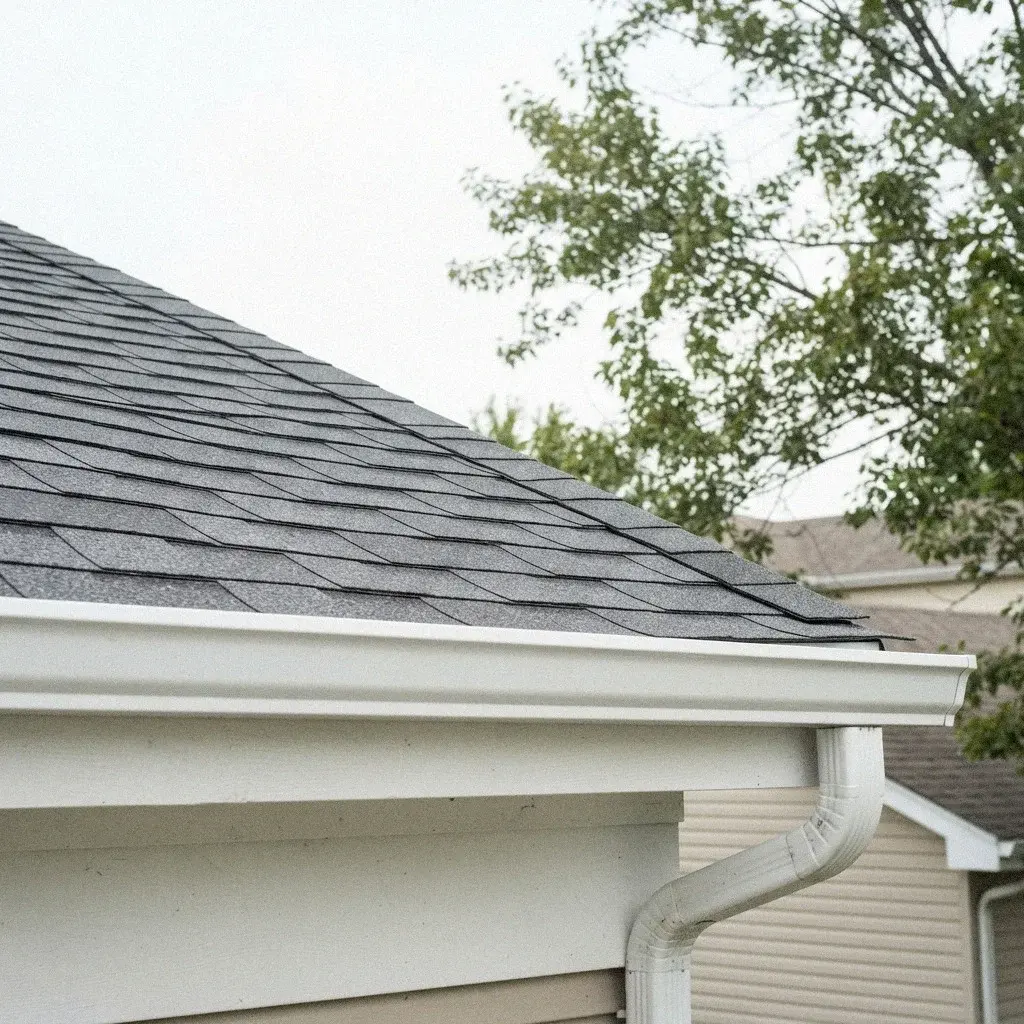
How Gutters and Downspouts Drain a Roof in Bellevue, WA
Gutter profiles, downspout counts, slope, and hardware that keep water moving off a Bellevue roof.
A properly sized gutter system in Bellevue means five-inch or six-inch K-style profile, enough downspouts to keep gutter runs under about 35 feet from an outlet, quarter-inch-per-ten-foot slope, and clear discharge points that carry water away from the foundation rather than pooling against it.
Gutter Profiles and Sizing
Gutters look like trim, but they are the part of a Bellevue roof that decides whether water leaves the building or sits against it. Every roof sheds its full load through a system of gutters, downspouts, and buried lines, and a weak link anywhere in that chain sends water where it should not go. Homes near Cougar Mountain, Somerset, and Bridle Trails carry heavy conifer cover, and the debris off that canopy is what pushes an otherwise adequate system past its limit.
The system has five jobs done in sequence: catch water off the shingle edge, carry it sideways along a pitched channel, drop it through a downspout, move it away from the foundation, and handle the overflow when a storm outpaces the design. Each stage has its own failure mode. A gutter that is sized right but pitched wrong backs up. A downspout that is sized right but poorly placed dumps water against a wall it was meant to protect.
This page treats drainage as one connected system rather than a list of parts, because that is how it actually fails. A clogged run overflows at the weakest hanger. A missing kickout flashing sends wall water into a gutter that was never meant to carry it. Bellevue's long wet-season stretches, more than any single storm, are what expose a system that was undersized or misaligned from the start.
Downspout Count and Placement
Gutter profile is the cross-section shape, and two dominate residential roofs here: K-style, which has a decorative front face resembling crown molding and holds more water per linear foot for its height, and half-round, a plain curved trough more common on older or higher-end homes. K-style is the practical default on most Bellevue houses because it clears more volume in a shallower hanging depth, which matters under a low fascia line on ramblers and split-levels common in older neighborhoods.
Sizing runs in two dimensions: profile depth and downspout diameter. Five-inch K-style paired with 2-by-3-inch downspouts is standard on most roof planes, but larger roof areas, steep pitches that accelerate runoff, or heavy tree cover call for six-inch gutters with 3-by-4-inch downspouts. A five-inch system on a large, steeply pitched roof plane is a common undersizing mistake, and it shows up as sheeting water over the front lip during a hard rain rather than a slow drip.
- Gutter pitch should run about a quarter inch of drop for every ten feet of run, sloping toward the nearest downspout outlet. Too flat and water sits and breeds silt; too steep and it looks crooked from the ground and still doesn't solve an undersized outlet count.
- Hidden hangers spaced roughly every twenty-four to thirty-six inches carry the gutter's weight and resist the pull of standing water and wet leaf debris. Wider spacing lets a run sag between hangers, which creates a low spot that collects water and overflows even on a correctly pitched gutter.
- Fascia board condition determines whether hangers hold. Hangers screw into the fascia and, ideally, into the rafter tails behind it, so soft or rotted fascia from years of trapped moisture won't hold a screw and needs replacing before new gutter goes up.
- Drip edge under the shingle and behind the gutter's back lip directs roof runoff into the gutter trough instead of behind it. Where drip edge is missing or was installed short, water tracks down the fascia and soaks the wood even with a perfectly sound gutter hung below it.
- Kickout flashing sits where a roof edge meets a sidewall near a gutter end, redirecting runoff away from the fascia and wall so water reaches the gutter trough directly rather than tracking behind it toward siding and framing at that corner.
- Outlet placement should match the roof's actual water concentration, not just even spacing along the fascia. Valleys, long roof planes, and areas below multiple roof sections dumping into one gutter run need an outlet close by, or that section overflows regardless of how clean the gutter is.
Slope, Hangers, and Attachment
Downspout count and placement follow roof area and roofline shape, not a fixed rule of thumb. Each downspout needs to serve a run short enough that water reaches it before the channel overtops, and long unbroken runs on larger Bellevue homes, especially the cut-up rooflines common on later two-story construction with multiple gables, often need an outlet at each end rather than one at a single low corner. Valleys concentrate flow fast enough that a downspout placed too far from one will overflow locally even when the rest of the run is fine.
Outlets, the fittings where gutter meets downspout, are a common weak point because they are the narrowest opening in the system and the first place needles and cone debris bridge and pack. A roof with heavy overhanging fir or cedar, the kind found through Somerset and the Lakemont side of Cougar Mountain, needs outlets checked more often than a roof in open sun, regardless of how new the gutters are.
- Downspout extensions carry water a few feet past the foundation, using either a hinged or telescoping piece resting on a splash block, or a rigid section running along grade. On a flat lot this is often enough; the goal is keeping discharge away from crawl space vents and foundation walls.
- Underground drain lines take discharge from the downspout base into a buried pipe that carries water further from the house, sometimes to a daylight outlet on a slope or to a dry well. These need a consistent downhill grade themselves or they silt up and back water into the downspout.
- Overflow at a gutter's high point usually traces back to one of three causes: too few downspouts for the roof area feeding that run, a clog at the outlet or in the downspout itself, or a slope so flat that water can't reach the outlet before the next storm adds more.
- On sloped Bellevue lots near Cougar Mountain, Lakemont, or the hillside streets above Lake Washington, discharge point placement matters as much as gutter capacity. Water released too close to a daylight basement wall or a crawl space foundation saturates soil that the house is built into rather than on.
Seamless Versus Sectional Gutters
Gutter pitch is the slight slope built into an otherwise level-looking run, usually a fraction of an inch drop across each section, angled toward the downspout. Too little pitch and water sits and breeds standing residue; too much and the far end runs dry while the near end floods during heavy flow. Pitch is set at installation through hanger height, not something adjusted later without resetting hangers, which is why a sagging run usually means hangers failed rather than the gutter itself.
Hanger spacing controls how much load the run can carry before it sags, and hidden hangers, the concealed brackets that clip inside the gutter's front lip and screw into the fascia board, are the standard fastener because they do not interrupt water flow the way old spike-and-ferrule hardware does. Spacing tightens on longer runs and on roofs that hold snow or wet debris longer, which includes shaded, tree-heavy lots more than open ones. A gutter that pulls away from the fascia in the middle of a run almost always traces back to hanger spacing that was too wide for the load.
| Gutter Type | Best Use | Tradeoff |
|---|---|---|
| Seam count | None along the run | Seam at every section joint |
| Leak risk | Lower over time | Higher at joints |
| Best fit for | Formed on site to length | Cut from stock lengths |
| Repair approach | Replace the damaged run | Swap the damaged section |
| Common material | Aluminum, formed by machine | Aluminum or vinyl, stock pieces |
Signs a System Is Undersized
Seamless gutter is formed on-site from a coil of aluminum, cut to the exact length of each fascia run, so the only joints are at corners and outlets rather than every ten feet. Sectional gutter is pre-cut lengths joined with connectors, which is more available for a quick patch but adds seams that are the first spots to leak as sealant ages. Most Bellevue reroofs that include gutter work default to seamless for that reason, though the choice matters less on a short, simple run than on a long one with few breaks.
Attachment ties the whole system to the roof structure. Hangers screw into the fascia board, which is itself nailed to the rafter tails, so a fascia board softened by trapped moisture behind an old gutter cannot hold hanger screws no matter how new the gutter is. This is why gutter work on an older Bellevue home sometimes uncovers fascia repair as a prerequisite rather than an afterthought, particularly on homes where the gutters were never pulled for a look behind them.
How Bellevue Rain Wears Down Gutters
Drip edge, the metal strip along the roof's eave that directs water off the shingle and into the gutter rather than behind it, has to align with the gutter's back edge or water tracks down the fascia instead of dropping into the channel. Kickout flashing does a related job at a different spot: where a roof-to-wall junction ends at a gutter, it diverts wall-plane water outward into the gutter instead of letting it run down the siding. A missing kickout is a frequent, hard-to-spot cause of siding damage that looks unrelated to the roof.
Once water clears the downspout, discharge extensions and splash blocks carry it away from the foundation, and on sloped Bellevue lots near Cougar Mountain, Somerset, or the Lake Washington shoreline, that discharge point matters because water dumped at the base of a slope saturates soil that a daylight basement or hillside foundation sits against. Underground drain lines route that same water further out or to an approved discharge point, and a line that has crushed or silted in fails quietly, since the downspout above it can look and drain fine right up until the buried section backs up.
Signs Your System Is Undersized
- Five-inch K-style is the common residential profile; six-inch handles steeper or larger roof planes and is worth it under heavy conifer canopy in wooded Bellevue neighborhoods.
- Seamless aluminum gutter, roll-formed on site, has fewer joints than sectional gutter and is the more common upgrade choice for a full gutter replacement.
- Downspout extensions and buried drain lines carry water away from the foundation, which matters on Bellevue's sloped lots near Cougar Mountain or Somerset, where water dumped close to the house saturates soil and can undermine a crawl space or daylight basement wall.
- Hidden hangers spaced every twenty-four to thirty-six inches, driven into fascia and rafter tails, keep the run from sagging under water weight.
- Drip edge and kickout flashing work with the gutter, not instead of it. Missing either one sends water behind the gutter and into the fascia or wall assembly.
- Half-round gutter shows up on some older or architecturally distinct Bellevue homes; it holds less water than K-style at the same width and pairs with round downspouts.
Frequently Asked Questions
What size gutters do I actually need?
Overflow at the front lip during a hard rain in Bellevue usually means the gutter is undersized for the roof area, pitched wrong, or has an outlet packed with conifer debris from nearby tree cover. It is worth checking the outlet first, since that is the narrowest point and the most common clog site, before assuming the whole system needs replacing.
How many downspouts should my roof have?
Six-inch K-style gutters handle more water per linear foot than five-inch, which matters on Bellevue roofs shaded by conifer canopy in Bridle Trails, Somerset, or the Cougar Mountain and Lakemont area, where debris load builds fast between cleanings. A steep, cut-up roofline from a two-story home also pushes more volume to fewer outlets, favoring the larger profile.
Why does water overflow the front of my gutter?
Seamless gutter is roll-formed on site from a coil, so a run has no joints except at corners and outlets, which cuts leak points on a long fascia run. Sectional gutter is installed in fixed lengths joined with connectors. Seamless costs more but holds up better through Bellevue's long wet season, when every joint is a chance for water to find wood.
Should I switch to seamless gutters?
A gutter with too few downspouts or too shallow a slope backs up and overflows during heavy rain, and the water that spills over the back edge runs down the fascia board and soffit rather than into the downspout. Over repeated wet-season storms that trapped moisture rots the fascia and the rafter tails behind it.
Where should downspout water actually go?
Extend the downspout discharge, whether through a splash block or a buried line, so water lands well away from the foundation and does not saturate the soil against a crawl space or daylight basement wall. On sloped Bellevue lots near Cougar Mountain or Lakemont, uncontrolled discharge close to the house adds to slope saturation.
Need Your Bellevue Drainage System Checked?
Talk with the licensed pros we connect you with about sizing and fixing a Bellevue home's gutter and drainage system.
Call (425) 380-0932